Continuing to do the Same Thing While Expecting a Different Result
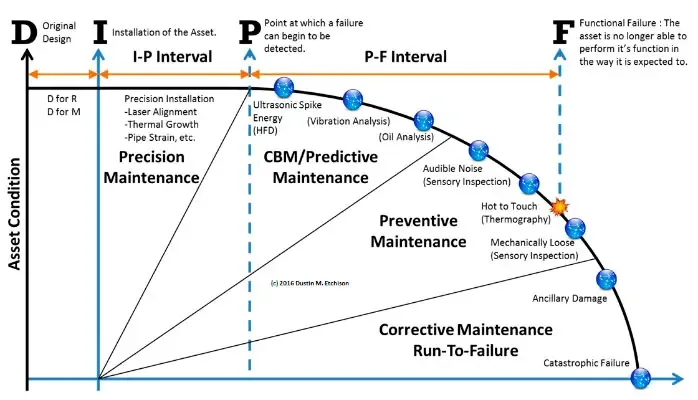
As problems occur with rotating equipment, the vibration analysis professionals of the world typically leap into action. Taking data, analyzing that data and drilling down to the root cause of the problem. Without acceleration enveloping equipment owners will likely first become aware of damage to the bearing by seeing an increase in overall vibration, and in some cases a rise in temperature. At this point in the failure the damage is more likely to be extensive than if the bearing faults were identified earlier in the P-F curve. In the very worst case, collateral damage has likely already occurred and the equipment will have already experienced one, if not many different failure modes or even functional failure.
How Acceleration Enveloping Works
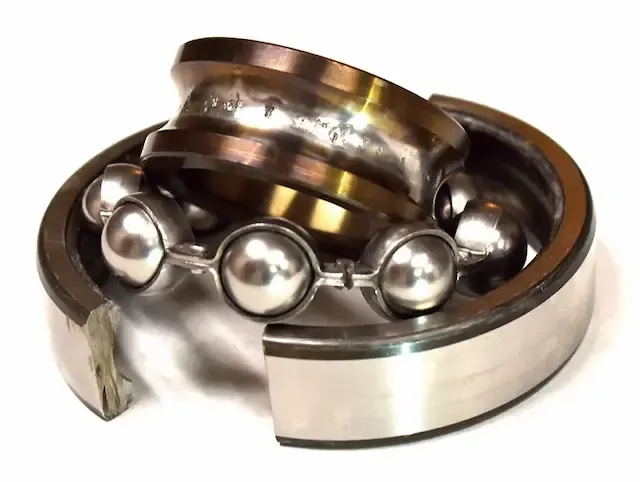
Acceleration enveloping is an incredibly powerful tool for vibration analysts and in many ways is superior to competing methods. Acceleration enveloping is a multi-step process that ERBESSD INSTRUMENTS® and our award winning Digivibe MX® software has automated to make bearing analysis easier. To understand how Digivibe MX® handles this it is important to first understand the basics.
With acceleration enveloping, we should first apply a band pass filter to the mix of low and high frequencies of a defective bearing’s unfiltered waveform. This will isolate only the bearing fault frequencies from within the signal that was collected. The filtered output generally identifies repeating high frequency data. This is often represented as a series of spiking energy bursts. These peaks are the impact of the rolling elements ringing down after coming into contact with the defect within the bearing.
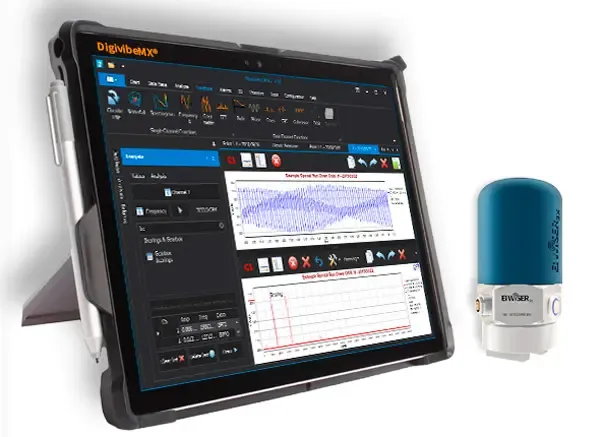
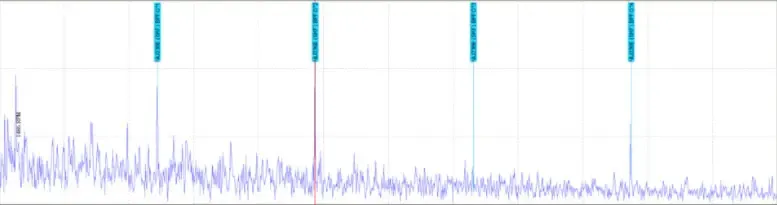
Next, we must pass the filtered output through an enveloping algorithm which then rectifies (demodulates) the waveform by inverting the negative part to the positive to create more density and then extracts the repetition rate of the energy spikes. This new enveloped signal helps the fault frequencies present and stand out from all other energy. The envelope assists in containing regularly spaced energy spikes such as an inner race or outer race defect. Acceleration enveloping is a great tool for synchronous energy analysis as the envelope helps contain and identify the regularly spaced synchronous peaks.
Digivibe MX®’s band pass filter range is 10x the RPM value specified in the machine point definition. This is why an RPM value must be specified when setting up the machine points. If the RPM is 0 or no RPM was specified, the band pass filter would be 0-10,000 CPM.
- Digivibe MX® first removes low frequencies below 10x RPM with an FFT
- Next, the FFT is inverted
- Then, Digivibe MX® converts all values from negative to positive, maximizing density
- Next, the envelope is applied by joining all the top points of the curve
- Lastly, we calculate the resulting FFT for analysis
Key Considerations
It is critical to understand that as with all vibration analysis some skill and experience are needed to interpret the data. Sometimes amplitude will decrease as a bearing fails, which could be missed by a novice analyst, whereas the experienced analyst might recognize this type of behavior and realize the imperfection may have simply smoothed out with wear and the bearing is actually still riding the P-F Curve toward functional failure.