Balance in your workshop. Or bring the workshop to the rotor.
ERBESSD INSTRUMENTS® balancing machines combine soft bearing suspension, Digivibe MX® measurement and Erby assistance to measure unbalance and guide its correction.
A suspension that needs no calibration or rigid concrete foundation, an electronic system that also works in the field, and an assistant to help throughout the process. From small turbochargers to large industrial rotors.
2 mg - 200 mg
Residual unbalance
50 g - 100 T
Rotor capacity
Soft Bearing
Technology
Soft bearing suspension
Precision without a rigid foundation
Soft bearing suspension allows the supports to move in response to rotor vibration. The sensors measure that response and Digivibe calculates the correction. That freedom of movement brings practical advantages to your operation.
The suspension needs no calibration
The sensors are what you calibrate, just as with any vibration analyzer. The suspension does not need mechanical calibration when you change rotors or relocate the machine. With the Balancing Wizard no trial weight is needed: the influence coefficients come from the rotor’s geometry. When you do balance with trial weights, the coefficients are stored and reused on the same or a similar rotor.
No special concrete foundation
You do not need to build a rigid concrete block to install the balancer. You need a stable, level surface that can support the machine and rotor. This makes it easier to install the machine in your workshop, relocate it or take it to the job site.
Bring the workshop to the rotor
Move a 20-tonne rotor? Bring the balancer instead.
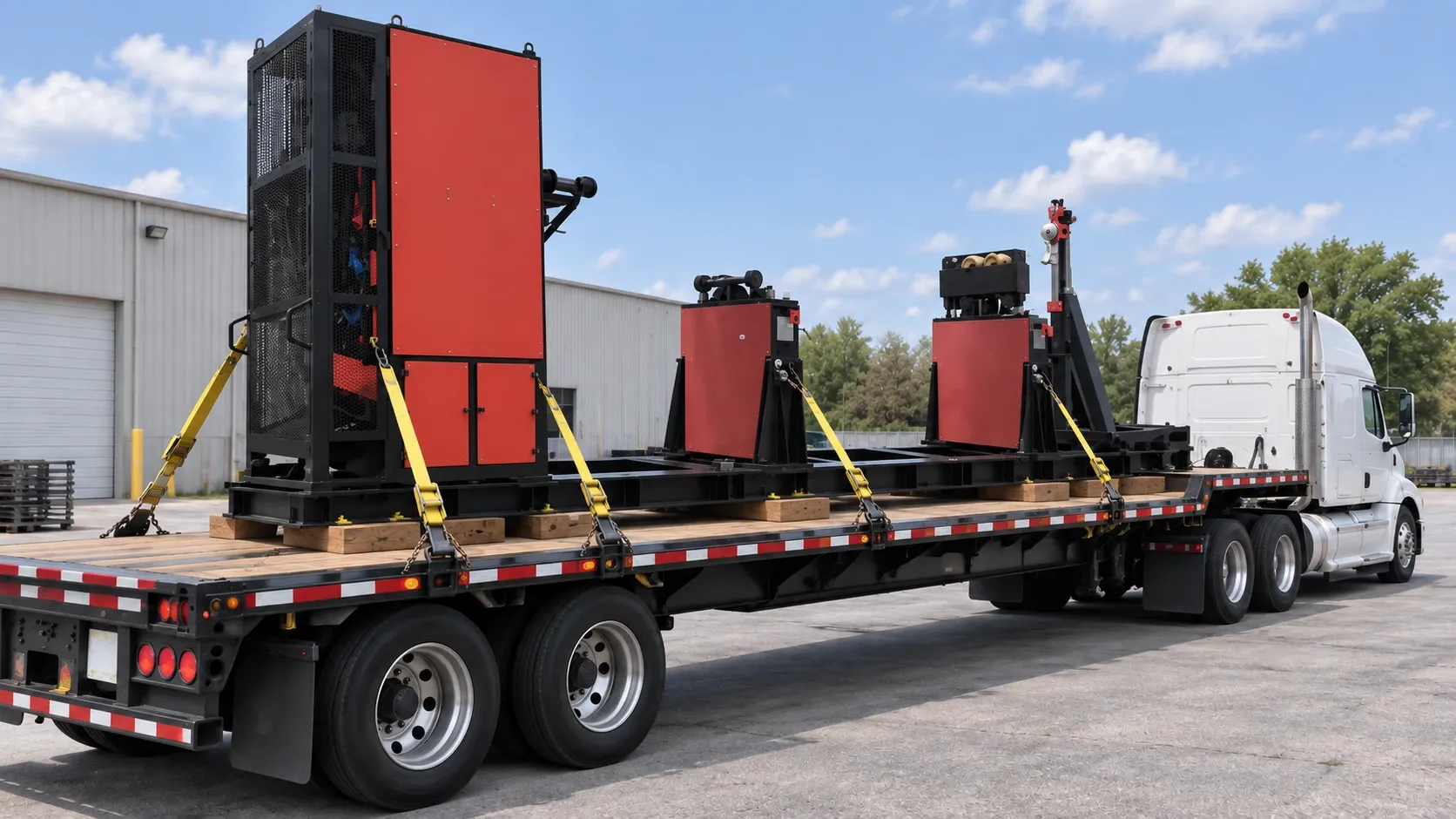
Consider this example: an 800 kg balancing machine and a 20-tonne rotor. Taking the machine to the plant can be much simpler than shipping the rotor to a balancing workshop. Soft bearing suspension opens up another way to work: balance close to where the rotor will operate.
-
Transport the balancer
The machine travels on a small truck with suitable payload capacity. The rotor stays at the plant.
-
Unload and connect
Position the balancer on a suitable surface, level it and connect the power and measurement system.
-
Balance on site
Mount the rotor on the balancer, make the corrections and verify the result. The rotor is ready to be reinstalled at the same location.
Less rotor transport, more flexibility for your service. The 800 kg and 20 tonnes illustrate the example; machine weight and capacity depend on the rotor and configuration selected.
Digivibe MX®
Your equipment also works away from the balancer
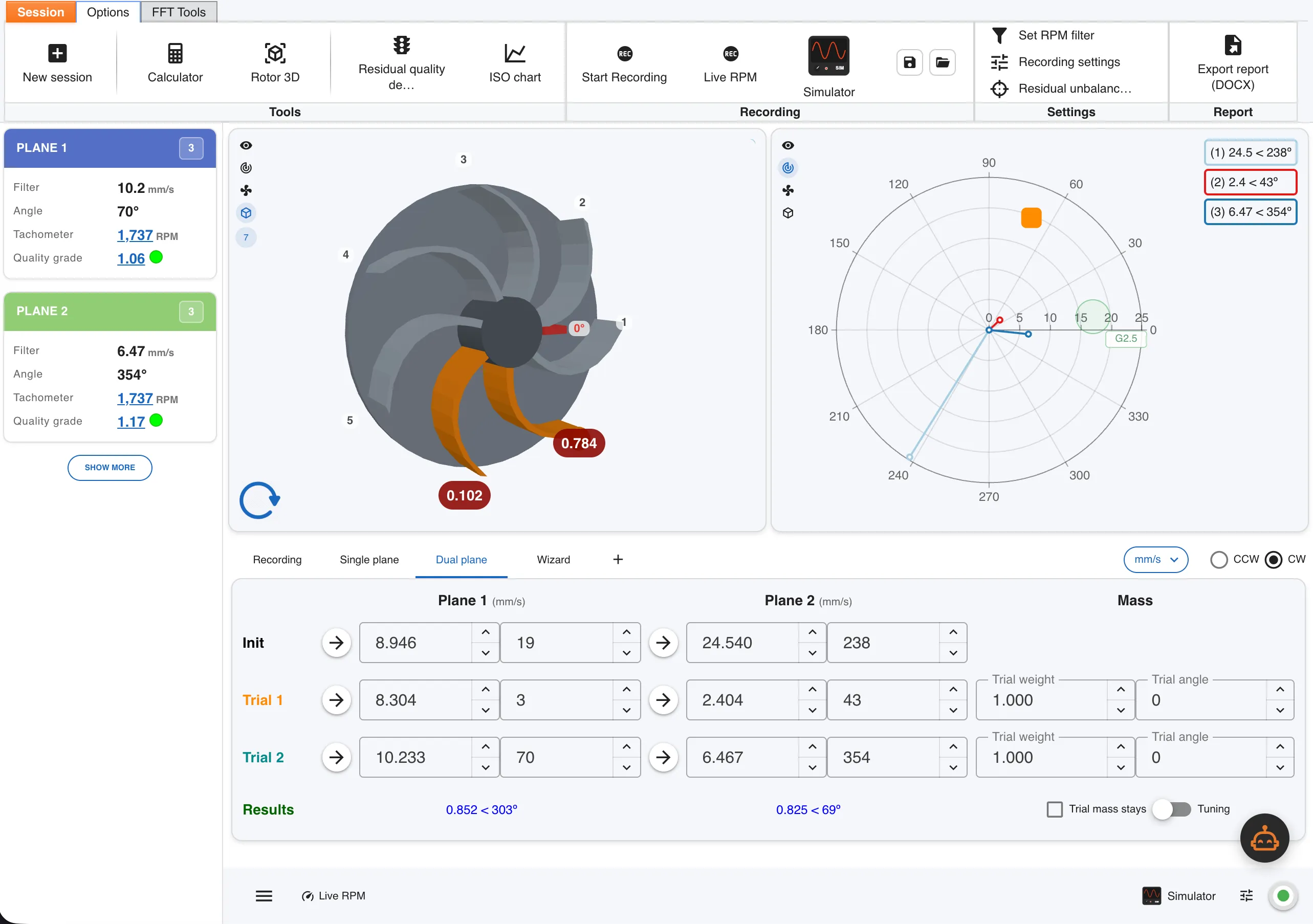
Take the electronic measurement system into the field. Use the interface and sensors with Digivibe MX® to balance equipment in its operating location and analyze vibration with the functions in your software configuration.
That gives you two ways to work on site: bring the balancing machine and mount the rotor on it, or bring the measurement equipment to work on an installed machine.
Measure, balance and analyze in the same software. When the problem calls for investigation beyond unbalance, continue with vibration analysis in Digivibe.
Erby · Balancing assistance
From a rotor photo to a guided balancing process
Take a photo of the rotor and provide one reference dimension. Erby uses that scale to estimate the remaining dimensions and help calculate rotor mass and balancing quality grade. Less manual data entry leaves more time for the job.
-
Take a photo and add a dimension
A photo and one known dimension give Erby a starting point for estimating the rotor geometry.
-
Review the calculations
Check the estimated dimensions and supply the necessary details, such as material and operating speed, to review the mass and applicable quality grade.
-
Get help at every step
Consult Erby throughout balancing: it can explain the next step, help interpret results and offer recommendations for moving forward.
You review the estimates and decide on the corrections. Erby assists you from preparation through final balance verification.
Erbessd EI-30 balancing machine is ideal for turbochargers and assemblies, as well as small rotors. It is a fully portable balancer that can be placed on any workbench. With this balancer you can make efficient and quick dynamic balancing machine jobs with great accuracy.
- Min Mass: 50 grams
- Max Mass: 30 kg
- Residual Unbalance: 0.2 g.mm/kg
- Speed: 900 - 15,000 RPM
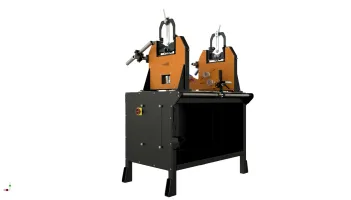
EI-150 dynamic balancing machine is designed to accurately balance rotors of any type. The length of its bedplate allows balancing rotors of up to 2 meters long to be mounted.
- Min Mass: 5 kg
- Max Mass: 150 kg
- Residual Unbalance: 0.2 g.mm/kg
- Speed: 900 - 5,000 RPM
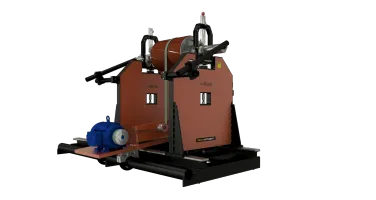
EI-300 dynamic balancing machine is designed to accurately balance rotors of any type. The length of its bedplate allows balancing rotors of up to 2 meters long to be mounted. Additionally, the EI-300 will allow you to make overhung rotor balancing thanks to its negative supports (optional).
- Min Mass: 15 kg
- Max Mass: 300 kg
- Residual Unbalance: 0.2 g.mm/kg
- Speed: 450 - 5,000 RPM
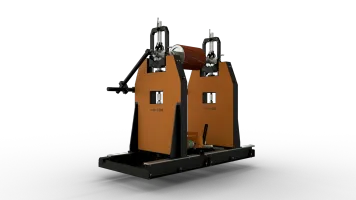
Balancing Machines Models EI-1000, 2000 and 3000 are one of the most versatile balancing machines, allowing you to balance anything, from small rotors to rotors weighing from 1 to 3 tons. This versatility makes these balancers our best sellers, as they adapt themselves to meet most rotor requirements in an average workshop. With these rotor balancing machines you can perform fast and accurate balancing jobs.
- Min Mass: 40 kg
- Max Mass: 1,000 / 2,000 / 3,000 kg
- Residual Unbalance: 0.2 g.mm/kg
- Speed: 300 - 4,500 RPM
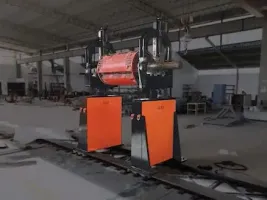
EI-4500 and EI-6000 balancing machines have been designed for heavy rotors. These machines will allow you to balance rotors ranging from 150 kg to 6 tons. As with all of our machines, these balancers have an option for overhung rotors. You can get an extension of the base frame to be able to reach balancing rotors longer than 6 meters if needed.
- Min Mass: EI-4500: 100 kg / EI-6000: 150 kg
- Max Mass: 4,500 kg / 6,000 kg
- Residual Unbalance: 0.2 g.mm/kg
- Speed: 450 - 3,500 RPM
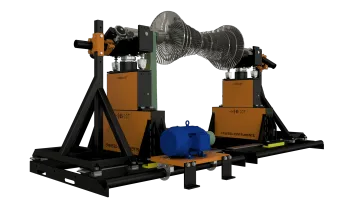
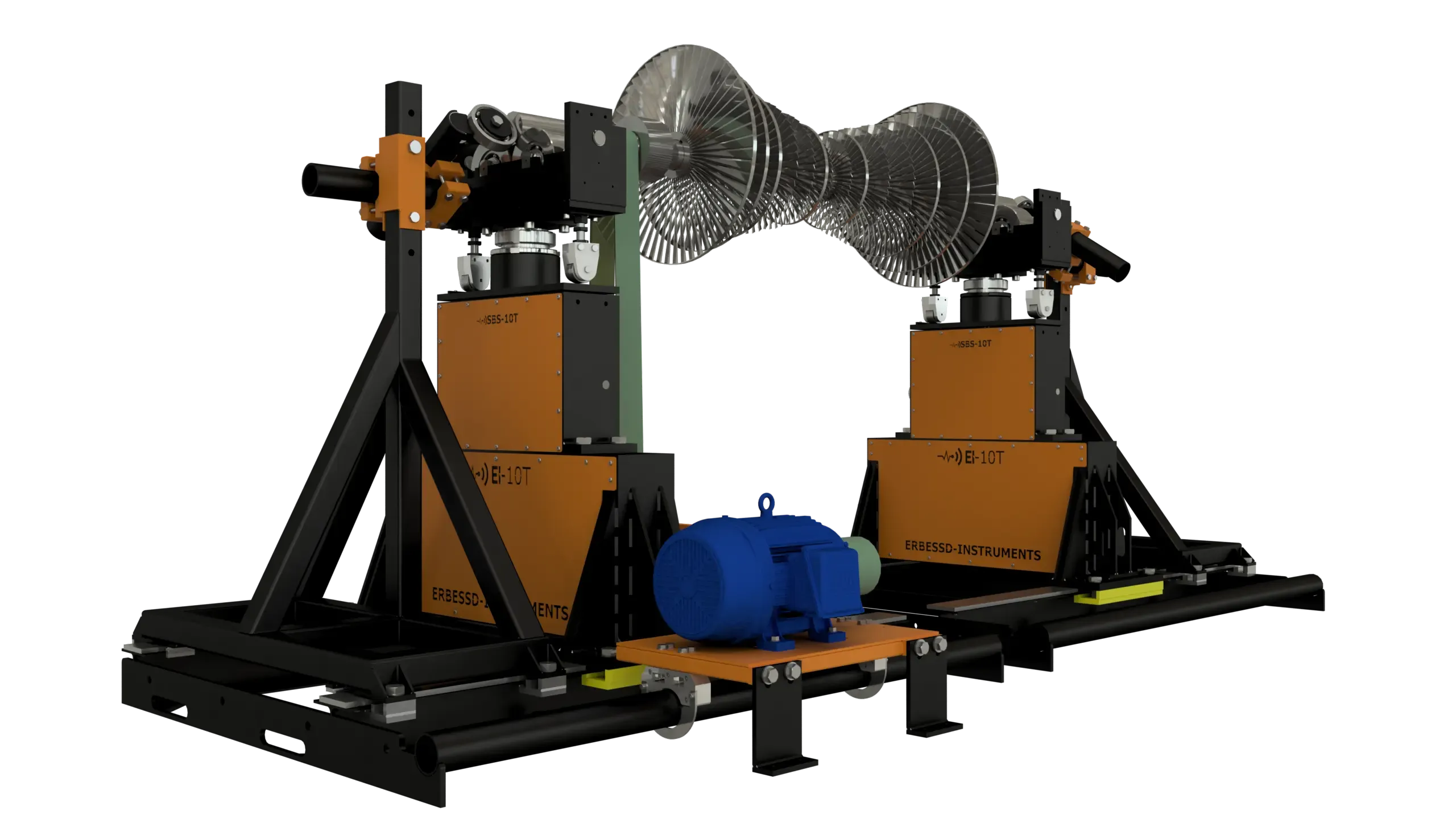
While we manufacture machines up to 100T in capacity (the 100T model is built to order), EI-10T is our most popular large balancing machine. This machine will allow you to balance tool rotors weighing from 200 kg to 10 tons. Extensions for extra large rotors are available as well as different roller work supports for smaller rotors.
- Min Mass: 500 kg
- Max Mass: 10,000 kg
- Residual Unbalance: 1 g.mm/kg
- Speed: 350 - 3,000 RPM
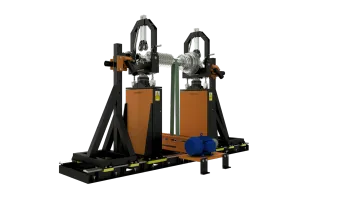
ERBESSD INSTRUMENTS®' EI-25T balancing machine is a heavy-duty solution for balancing large rotors with accuracy and stability. It is well suited for industrial applications involving rollers, electric rotors, crankshafts, fans, and other large rotating components, offering a reliable option for companies that want consistent balancing quality and strong performance in everyday operation.
- Min Mass: 50 kg
- Max Mass: 25,000 kg
- Residual Unbalance: 1 g.mm/kg
- Speed: 150 - 2,800 RPM
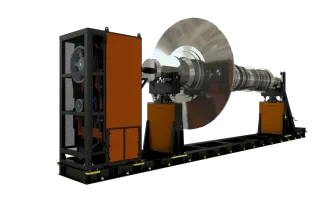
ERBESSD INSTRUMENTS®' 50-ton balancing machine is a heavy-duty solution for balancing very large rotors with accuracy and stability. It is well suited for applications involving paper mill rollers, generator and motor rotors, crankshafts, fans, blowers, and other large rotating components, offering a reliable option for consistent balancing quality in daily operation.
- Min Mass: 100 kg
- Max Mass: 50,000 kg
- Residual Unbalance: 1 g.mm/kg
- Speed: 160 - 2,500 RPM
Compare
EI Series at a glance
The figures are the same ones shown on each card above. The models with a link have their own page. How to weigh these figures against the rest of the market, type by type and specification by specification, is in The Best Balancing Machine in 2026: How to Choose One.
| Model | Min. mass | Max. mass | Residual unbalance | Speed |
|---|---|---|---|---|
| EI-30 | 50 g | 30 kg | 0.2 g.mm/kg | 900 - 15,000 RPM |
| EI-150 | 5 kg | 150 kg | 0.2 g.mm/kg | 900 - 5,000 RPM |
| EI-300 | 15 kg | 300 kg | 0.2 g.mm/kg | 450 - 5,000 RPM |
| EI-1000 | 40 kg | 1,000 kg | 0.2 g.mm/kg | 300 - 4,500 RPM |
| EI-2000 | 40 kg | 2,000 kg | 0.2 g.mm/kg | 300 - 4,500 RPM |
| EI-3000 | 40 kg | 3,000 kg | 0.2 g.mm/kg | 300 - 4,500 RPM |
| EI-4500 | 100 kg | 4,500 kg | 0.2 g.mm/kg | 450 - 3,500 RPM |
| EI-6000 | 150 kg | 6,000 kg | 0.2 g.mm/kg | 450 - 3,500 RPM |
| EI-10T | 500 kg | 10,000 kg | 1 g.mm/kg | 350 - 3,000 RPM |
| EI-25T | 50 kg | 25,000 kg | 1 g.mm/kg | 150 - 2,800 RPM |
| EI-50T | 100 kg | 50,000 kg | 1 g.mm/kg | 160 - 2,500 RPM |
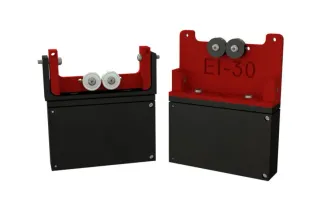
Build your own turbo balancing machine, either on the base of your milling machine or on a station of its own. SBS-30 soft bearing suspensions help you build a very versatile balancer with the high accuracy of soft-bearing systems. Blueprints for the design can be downloaded upon payment of your SBS system.
- Application: Turbo balancing
- Type: Soft Bearing
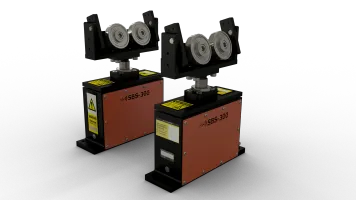
SBS-300 soft bearing suspensions help you build your own balancing machine without sacrificing the high accuracy of soft-bearing systems. Blueprints for the machine's design can be downloaded upon payment of your SBS system.
- Max Mass: 300 kg
- Type: Soft Bearing
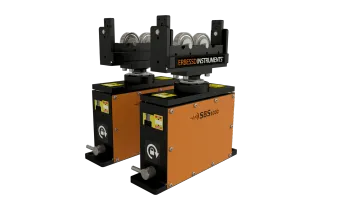
With SBS-1000 soft bearing suspensions, you will manufacture one of the most versatile balancing machines available. The SBS-1000 allows you to balance anything from small 3 kg rotors to medium sized 1,000 kg rotors. Blueprints for the design can be downloaded upon payment of your SBS system.
- Min Mass: 3 kg
- Max Mass: 1,000 kg
- Residual Imbalance: 5 mg
- Speed: 450 - 5,000 RPM
- Type: Soft Bearing
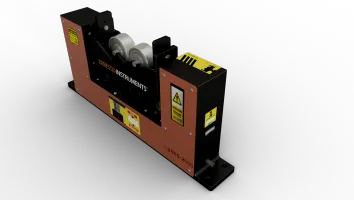
SBS-2000 allows you to create a balancer for large rotors weighing up to 2,000 kg. It supports balancing jobs in two planes as well as in a single plane and cantilever. Assemble the bedplate with the desired length so you are not limited by rotor size.
- Min Mass: 7 kg
- Max Mass: 2,000 kg
- Residual Imbalance: 10 mg
- Speed: 450 - 3,000 RPM
- Type: Soft Bearing
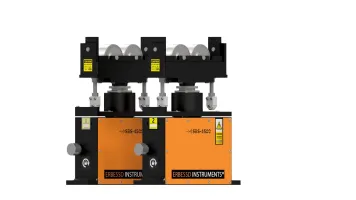
SBS-4500 lets you balance large rotors. The base is simple to assemble and features the well-known precision of soft-bearing rotor balancing machines at a very affordable price. Blueprints for the design can be downloaded upon payment of your SBS system.
- Min Mass: 150 kg
- Max Mass: 4,500 kg
- Residual Imbalance: 80 mg
- Speed: 350 - 3,000 RPM
- Type: Soft Bearing
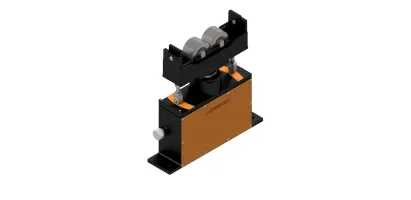
SBS-6000 lets you balance large rotors. The base is easy to assemble, so you should not have any problem starting work right away. Features the precision of soft-bearing rotor balancing machines at a very affordable price.
- Min Mass: 150 kg
- Max Mass: 6,000 kg
- Residual Imbalance: 80 mg
- Speed: 350 - 3,000 RPM
- Type: Soft Bearing
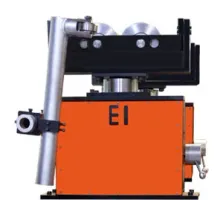
SBS-10T lets you balance large rotors. The frame is simple to put together, so you should be up and running in a short time. It features the well-known precision of soft-bearing balancing machines at a very affordable price. Blueprints for the rotor balancing machine can be downloaded upon payment of your SBS system.
- Min Mass: 200 kg
- Max Mass: 10,000 kg
- Residual Imbalance: 120 mg
- Speed: 350 - 2,500 RPM
- Type: Soft Bearing
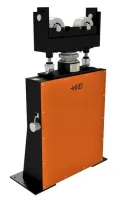
Erbessd's SBS-25T suspensions are meant for large equipment, allowing you to balance very large rotors. The frame is easy to assemble using the blueprints we provide. It features the well-known precision of soft-bearing balancing machines at a very affordable price. Blueprints can be downloaded upon payment of your SBS system.
- Min Mass: 400 kg
- Max Mass: 25,000 kg
- Residual Imbalance: 200 mg
- Speed: 120 - 1,800 RPM
- Type: Soft Bearing
Compare
SBS Series at a glance
All the suspensions are soft bearing. The figures are the same ones shown on each card above; the models with a link have their own page. SBS-30 is the suspension for turbo balancing machines and SBS-300 tops out at 300 kg: their full figures are on their own pages.
| Model | Min. mass | Max. mass | Residual imbalance | Speed |
|---|---|---|---|---|
| SBS-30 | — | — | — | — |
| SBS-300 | — | 300 kg | — | — |
| SBS-1000 | 3 kg | 1,000 kg | 5 mg | 450 - 5,000 RPM |
| SBS-2000 | 7 kg | 2,000 kg | 10 mg | 450 - 3,000 RPM |
| SBS-4500 | 150 kg | 4,500 kg | 80 mg | 350 - 3,000 RPM |
| SBS-6000 | 150 kg | 6,000 kg | 80 mg | 350 - 3,000 RPM |
| SBS-10T | 200 kg | 10,000 kg | 120 mg | 350 - 2,500 RPM |
| SBS-25T | 400 kg | 25,000 kg | 200 mg | 120 - 1,800 RPM |
Do it yourself
Build your own balancing machine
With ERBESSD INSTRUMENTS® soft bearing suspensions you can build your own balancing tool and have the same quality. ERBESSD INSTRUMENTS® provides you with the soft bearing suspensions, as well as the analysis system, which is the most critical part. We can provide you with the blueprints for the rest of the parts as well. You will also build your own bedplate and your own balancing machine.
Advantages of building your own Erbessd balancing machine
- Save money.
- Avoid high shipping costs.
- Avoid delays due to sea freight shipping.
- Adjust the length and height of your machine according to your needs.
- Adapt the dimensions of the machine to your space requirements.
Frequently asked questions
Does soft bearing suspension need calibration?
No. The sensors are what you calibrate, just as with any vibration analyzer. Changing rotors or relocating the machine does not require suspension calibration. Nor a trial-weight run with the Balancing Wizard, which takes the influence coefficients from the rotor’s geometry; when trial weights are used, the coefficients are stored for the next time.
Do the balancing machines need a special foundation?
They do not require a rigid concrete foundation. Install them on a stable, level surface that can support the weight of the machine and rotor.
Can I take the balancing machine to my customer’s plant?
Yes, with the appropriate configuration and transport. Take the machine to the site, unload it, level it, connect it and mount the rotor for balancing. For large rotors, moving the balancer can be simpler than shipping the rotor to a workshop.
Can I use the electronics without taking the balancing machine?
Yes. Take the interface and sensors to use Digivibe MX® in the field. You can balance an installed machine and analyze vibration using the functions included in your software configuration.
How does Erby help prepare and perform balancing?
From a photo and one reference dimension, Erby estimates the remaining rotor dimensions and helps with mass and quality grade calculations. You review the data and supply any additional information needed. During the process, you can ask for explanations and recommendations at each step.
Which is more accurate, soft bearing or hard bearing?
Soft bearing, because of its freedom of movement. Hard-bearing machines are used more in automated installations and series production, where the priority is cycle time rather than the last increment of accuracy.
Do I have to balance at the rotor’s operating speed?
No. Soft-bearing suspensions let you balance at a fraction of the operating speed, as long as it stays above the system’s resonance frequency. The quality grade is calculated for the full operating speed regardless.
What is the largest balancing machine you sell?
Up to 100 tonnes. The 50-tonne EI-50T is the largest standard model; the 100-tonne machine is built to order. Above that, our design team assesses the case according to the intended use.
Can crankshafts be balanced?
Yes, following the correct technique. Crankshafts require bob weights at every point where a piston acts, to emulate its mass. The masses are defined by the engine manufacturer, not by the balancing machine.
How do I know the balance is within standard?
The software calculates the residual unbalance and compares it against the ISO quality grade for that type of rotor, showing it on the standard’s chart. You do not finish “when it vibrates little”: you finish when the number falls inside the required grade.
Is it easy to generate a balancing report?
Yes — one click generates the complete report, with the initial and final state of the process.
Can I balance if I have no optical sensor or tachometer?
Yes, with the four-run (4-Run) method: it balances by measuring amplitude only, with no phase reference. It is slower — there are more runs — but it solves the case where reflective tape cannot be fitted or the shaft is out of reach.
Can I balance in three planes?
Yes. The software does one, two and three planes, plus the Wizard and the four-run method.
What if the rotor’s vibration will not come down no matter how much weight I add?
It is almost never unbalance. The usual causes are resonance — the rotor or its structure has a natural frequency near operating speed — mechanical looseness, or a bent shaft.
At that point the right tool is not balancing but a bump test and phase analysis, and both are in the same software.
Does the EI WiSER® 1X work for balancing?
Yes. The EI WiSER® 1X has 2 channels: one for the internal accelerometer and one for the optical sensor, with the same connector as the 3X.
Both sensors balance in one, two and three planes with the corresponding licence (Digivibe MX® for more than one plane). With them, multi-plane balancing means moving the sensor from one plane to the other on each run and recording once per plane.
With the GX-400 that is not necessary: it takes two independent accelerometers, one per plane, so a single recording per run is enough.
Can the EI WiSER® 3X and 1X be used with Digivibe MX®?
Yes. The EI WiSER® family and the GX-400 work in both Digivibe MX® and WiserVibe: they are sibling applications sharing the same code — WiserVibe for mobile, Digivibe MX® for Windows PCs.
Can the GX-400 interface be used with mobile devices?
Yes. Being a wired interface, it connects to the device through a USB adapter: USB-C for Android and recent iPhone/iPad, Lightning for earlier iPhones.
How far away can I place the laser (optical) sensor?
From 15 cm up to 5 m.
You need to fit a piece of reflective tape — red is recommended — and check that the blue LED on the back lights up each time the beam crosses the tape.