Four types compete for the purchase. Ten specifications decide it. The one that pays for itself is the one that can also leave the workshop.
Short answer. The best balancing machine is the one sized to the rotors you actually balance, from the lightest to the heaviest, that reaches the ISO 21940 grade those rotors require and does not lock you into a foundation, a calibration routine or a single place of work. This guide is about industrial balancing machines for rotors: fans, impellers, armatures, turbochargers, pump shafts. If you are looking for a wheel balancer for a tyre shop, that is a different machine and a different search. Ten specifications decide the purchase: minimum and maximum rotor mass, rotor geometry, drive type, speed range, achievable residual unbalance, suspension type, foundation, software, whether the electronics can leave the machine, and total cost over five years. Of the four types on the market, soft-bearing, hard-bearing, vertical and field balancing kit, only the soft-bearing machine covers the widest range of rotors with the best sensitivity and can travel to the rotor, which is why our EI Series is built that way.
This guide is the list I would want if I were buying rather than manufacturing. It follows the order in which the decisions actually happen: first which rotors the machine can take, then how well it measures them, then what you live with for the next five years. Everything before the last section applies whoever you buy from.
What is a balancing machine?
A balancing machine is a machine that spins a rotor on its own supports, measures the vibration or force that the rotor’s unbalance produces at each support, and calculates how much mass to add or remove, and where, so that the rotor’s centre of mass returns to its axis of rotation. The rotor is removed from its machine, mounted on the balancer, corrected and reinstalled.
Unbalance is an excess of mass on one side of the rotor. Spinning, that excess pulls the shaft outwards once per revolution, and the pull grows with the square of the speed: double the speed, four times the force. That force is what wears bearings, loosens foundations and shows up as the 1× peak in every vibration spectrum. A balancing machine measures it under controlled conditions, on supports whose response is known, so the correction can be calculated instead of guessed.
Four words get used interchangeably and they are not the same thing:
| Term | What it is | What it is not |
|---|---|---|
| Balancing machine | Supports, a drive and a measuring system. The rotor comes to the machine | A tool for balancing a rotor that is still installed |
| Field balancing | A portable analyzer, sensors and a tachometer. The rotor stays in its own bearings | A substitute for a balancer when the rotor’s own structure resonates or is loose |
| Balancing suspension | The supports alone, sold as parts so you can build your own machine | A complete machine: you add the bed, the drive and the measuring system |
| Wheel balancer | A machine for car and truck wheels, with an adaptor for the rim | An industrial balancing machine. Different rotors, different tolerances, different price |
If your rotor cannot be removed, the right purchase is a field balancing kit and not a machine. If it can, keep reading.
Type of machine
The four types of balancing machine, compared
Before the specifications, the type. The way the supports hold the rotor decides most of what follows: how sensitive the machine is, whether it needs a foundation, whether it needs calibrating, and whether it can ever leave the workshop.
✔ typically available · — typically not available
| Soft-bearing | Hard-bearing | Vertical | Field balancing kit | |
|---|---|---|---|---|
| Installation | ||||
| No rigid concrete foundation required | ✔ a stable, level floor | — usually needs a rigid base | — usually needs a rigid base | ✔ nothing to install |
| Can travel to the rotor | ✔ on a truck, with the electronics | — | — | ✔ |
| Suspension needs no calibration when the rotor changes | ✔ the sensors are what you calibrate | ✔ permanent calibration | ✔ permanent calibration | — trial weights every time |
| Which rotors it takes | ||||
| Rotor mass range on one design (typical) | 50 g to 50 t standard, 100 t on request | 1 kg to 100 t and beyond | up to about 1 t | whatever is installed |
| Sensitivity for very light rotors | ✔ down to 50 g | — limited | — | — |
| Disc-shaped rotors without their own shaft | — on an arbor | — on an arbor | ✔ | — |
| Balances the rotor without removing it | — | — | — | ✔ |
| How well it measures | ||||
| Balances at a fraction of the operating speed | ✔ above the suspension resonance | ✔ | ✔ | — at operating speed |
| Residual unbalance achievable (typical) | 0.2 g·mm/kg | per model | per model | limited by the machine itself |
| Trial-weight runs not required | ✔ with the rotor wizard, or with stored coefficients | ✔ permanent calibration | ✔ permanent calibration | — trial weights, unless the coefficients of an earlier job are stored |
| Cycle time for series production | ✔ one measuring run per rotor | ✔ | ✔ | — |
| Software and after | ||||
| One, two and three planes | ✔ | ✔ | — usually one or two | ✔ |
| Same electronics also does vibration analysis | ✔ with Digivibe MX® | — usually a dedicated console | — usually a dedicated console | ✔ |
| Report against the ISO 21940 grade | ✔ | ✔ | ✔ | ✔ |
| Build it yourself from the suspensions | ✔ | — | — | — |
| Capabilities typically available, out of the rows above | 11 / 13 | 6 / 13 | 6 / 13 | 6 / 13 |
Typical values for each type of machine, not the specification of any one product. Always confirm against the datasheet of the model you are quoting.
Soft-bearing. The supports are free to move, and the sensors measure that movement. That freedom is what gives the machine its sensitivity: a 50-gram turbocharger wheel moves a soft support; it does not move a rigid one. It is also what frees the machine from the concrete block, because the machine does not depend on the floor to stay still. It does not cost you a trial-weight run either. With the rotor wizard the influence coefficients come from the rotor’s geometry, so the measuring run is the only run before the correction. And when you balance with trial weights instead, the coefficients are stored with the session and can be reused on the same rotor, or a similar one, without a trial weight the next time.
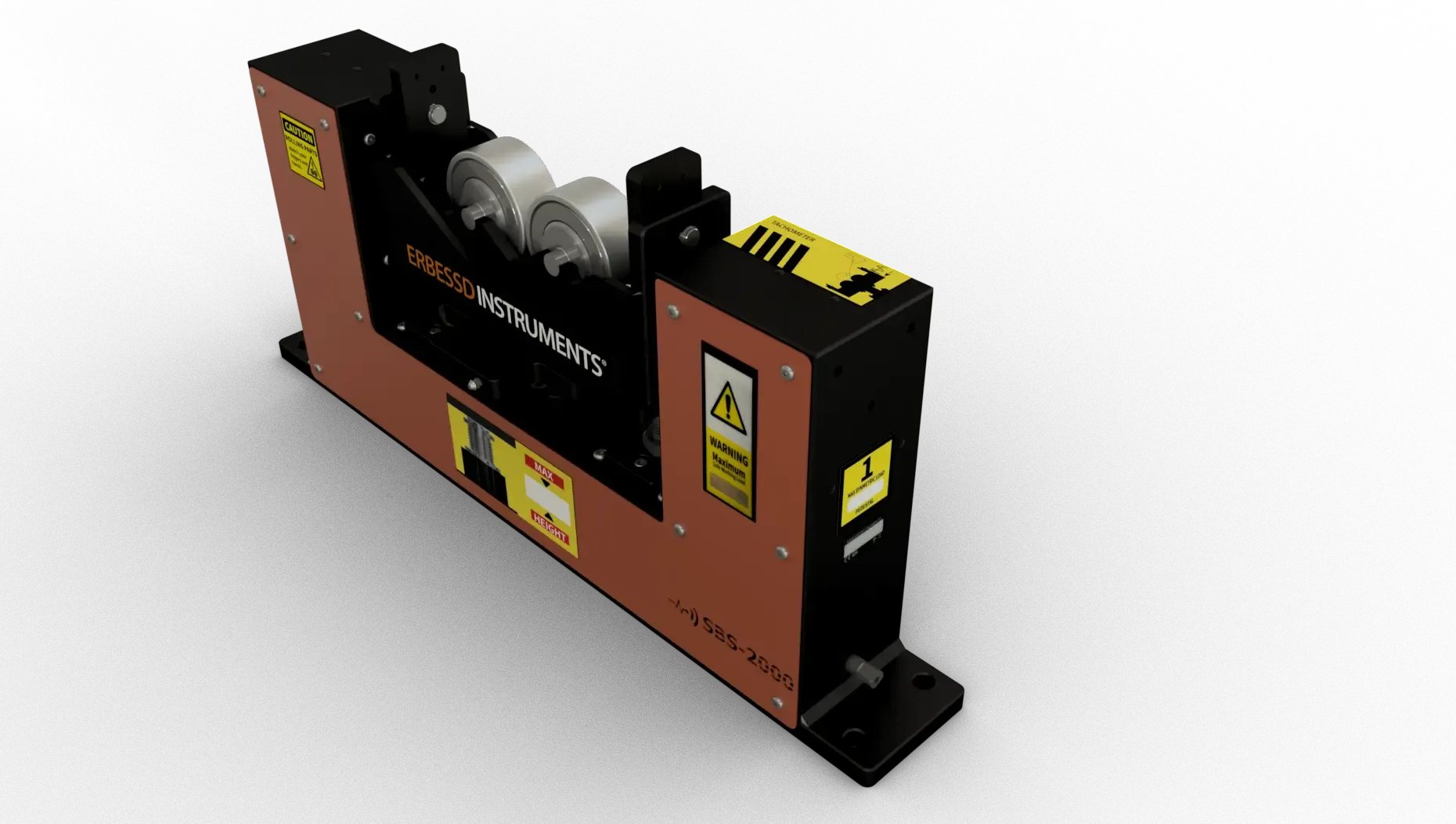
Hard-bearing. The supports are stiff and the machine reads force, with a calibration that is set at the factory and does not change from rotor to rotor. Its real advantage is the very first rotor of a type it has never seen: it reads correctly without a wizard estimate or stored coefficients. They pay for that with a rigid, heavy base and with less sensitivity on light rotors.
Vertical. For rotors that have no shaft of their own: brake discs, flywheels, impellers, clutch plates. The rotor sits on a spindle and spins about a vertical axis. Excellent for what they are built for, and no use for a shaft.
Field balancing kit. Not a machine: an analyzer, an accelerometer and a tachometer. The rotor stays in its bearings and spins at its own speed. It is the only option for a rotor that cannot come out, and it is limited by the rotor’s own structure: if the foundation resonates or a bearing is loose, no amount of weight brings the vibration down. The same Digivibe MX® that runs our balancing machines runs the kit, so most of our customers own both.
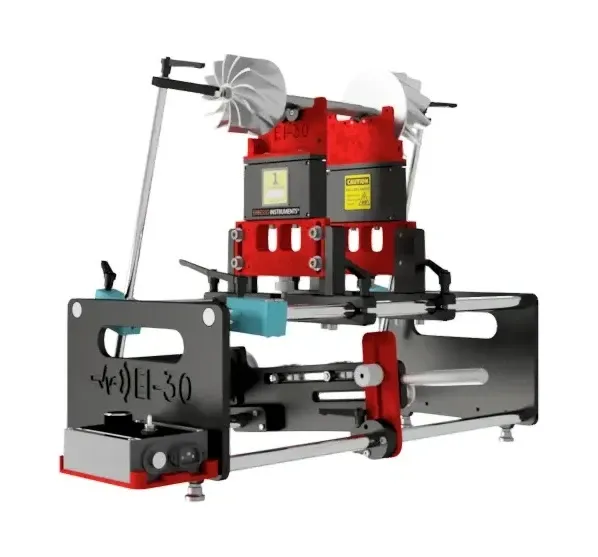
Ours are in the first column. The EI Series goes from the EI-30 for turbochargers, 50 grams and 15,000 RPM, to the EI-50T for 50-tonne rotors as a standard model, and to 100 tonnes on request. All of them are soft-bearing, none needs a foundation, and the electronics that measure on the bed also balance and analyse in the field.
The ten specifications that decide the purchase
The whole list first, then each one in detail. If you read nothing else, this table is the guide:
| What to check | What “good” looks like | How to verify it before you buy |
|---|---|---|
| 1. Rotor mass range | Covers your lightest rotor and your heaviest, with margin | List your ten most common rotors by mass. Check the minimum, not only the maximum |
| 2. Rotor geometry | Diameter, length, bearing span and journal diameters all fit | Send drawings of your three awkward rotors and ask for the fixture |
| 3. Drive type | Belt for most rotors, end drive for those without a belt surface, belt for turbos too, resting on the shaft | Ask how the machine drives a rotor with no free surface for a belt |
| 4. Speed range | Balances well below operating speed, above the suspension resonance | Ask for the minimum balancing speed and for the resonance of the suspension |
| 5. Residual unbalance | Below the ISO 21940 grade your rotors require, with margin | Ask for the figure in g·mm/kg at your rotor mass, not the best case on the brochure |
| 6. Suspension and calibration | Soft-bearing for sensitivity and portability; hard-bearing if you need a first-run reading on rotors you have never seen | Ask what has to be recalibrated when the rotor changes, and who does it |
| 7. Foundation | None, or a level floor that carries machine plus rotor | Ask for the civil works drawing. If there is one, price it |
| 8. Software | One, two and three planes, calculator, four-run method, editable ISO 21940 report | Balance one of your rotors on a demo, start to finish, report included |
| 9. Electronics that leave the bed | The measuring system also balances installed machines and analyses vibration | Ask whether the console is tied to the machine or is a general-purpose analyzer |
| 10. Total cost | Known for five years: tooling, spares, licences, updates, shipping and installation | Ask for everything in writing, and ask what a replacement sensor or cable costs and takes |
1. Rotor mass range: check the minimum, not only the maximum
Every brochure leads with the maximum mass. The number that catches buyers is the minimum. A machine rated for 6 tonnes may not react to a 20-kilogram armature at all: the rotor is too light to move the supports, and the machine reports a beautiful zero that means nothing.
Make the list of the rotors you balance in a normal year, lightest to heaviest, and buy for both ends. If the spread is too wide for one bed, which happens once you go past a few tonnes, two machines are cheaper than one machine that lies about the small rotors.
2. Rotor geometry: the awkward ones decide the fixture
Diameter clears the bed. Length fits between the supports. Bearing span fits the support travel. Journal diameters fit the rollers. Each of those is a number on the datasheet, and each one has a rotor in your workshop that sits just outside it.
Send the drawings of your three most awkward rotors before you sign, and ask what fixture or adaptor each one needs. A fixture designed after delivery costs more than one designed before.
3. Drive type: how the rotor is going to spin
Most rotors are driven by a belt around a plain section of the shaft: simple, fast to set up, no coupling to align. Rotors without a free belt surface, or with a keyed end, are driven from the end through a universal joint. Turbocharger cartridges are driven by a belt resting on the shaft too: on floating supports it is precise enough for a 50-gram wheel, and it is a well-proven arrangement.
Ask how the machine drives a rotor that has nowhere for a belt. If the answer is “we make a fixture”, ask for the price of that fixture on your rotor.
4. Speed range: you do not balance at operating speed
A balancing machine does not need to reach the rotor’s running speed. Unbalance is a mass; it does not change with speed, only its force does. What the machine needs is to spin above the resonance of its own suspension, where the measurement is stable, and below anything that endangers the rotor. On a soft-bearing machine that can be a small fraction of operating speed.
The quality grade is calculated for the operating speed regardless, so a rotor balanced at 800 RPM on the bed is balanced for 3,600 RPM in the plant. Ask for the minimum balancing speed and for the suspension resonance; the gap between them is where your rotors will be balanced.
5. Residual unbalance: the number that has to fit your grade
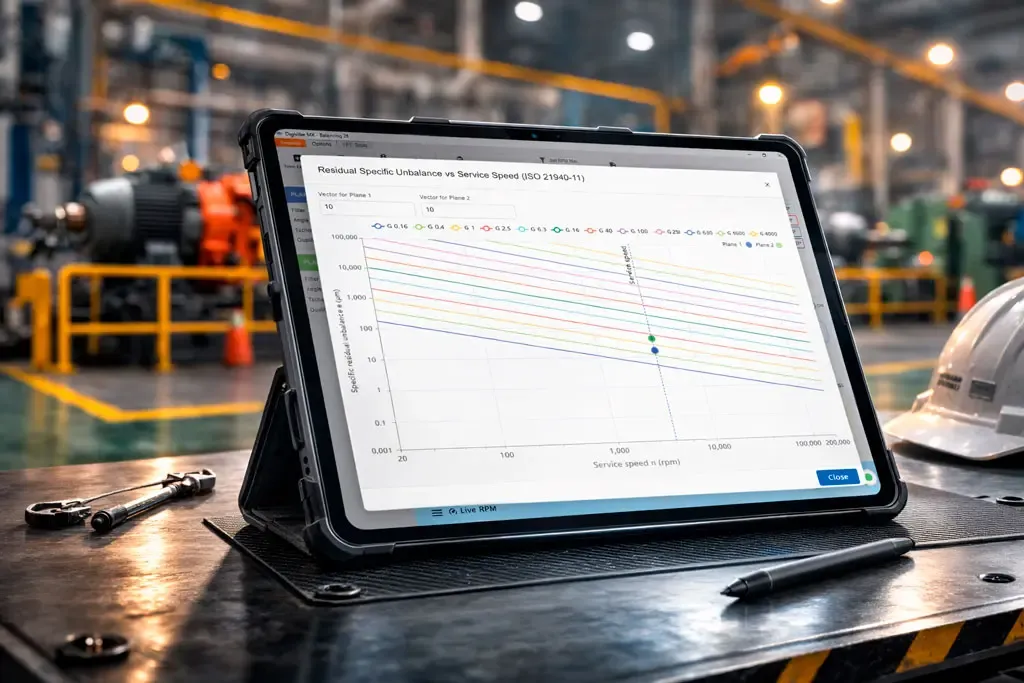
The rotor arrives with an unbalance and leaves with a smaller one. How small is the residual unbalance, expressed per kilogram of rotor: g·mm/kg. ISO 21940-11 says which grade each type of rotor needs, from G 0.4 for gyroscopes to G 40 for car wheels, and the grade plus the operating speed gives the permissible residual.
The machine has to reach that residual with margin, at your rotor mass. A figure of 0.2 g·mm/kg is what our EI Series achieves up to 6 tonnes; the heavy machines achieve 1 g·mm/kg. Ask the vendor for the same number, and ask at which mass it was measured.
6. Suspension and calibration: the choice underneath everything
This is the decision the four types above were really about. A hard-bearing machine is calibrated once at the factory and reads force; put a rotor on it that it has never seen and the first reading is already right. A soft-bearing machine reads the movement of a free support, which is what makes it sensitive to light rotors and indifferent to the floor it stands on. What it needs is the rotor’s influence coefficients, and there are two ways to get them: the rotor wizard derives them from the rotor’s geometry, so the measuring run is the only run before the correction; or one trial-weight run measures them, after which they are stored with the session and reused on the same or a similar rotor. Either way, every machine, of any type, needs that first measuring run without weights: that is how the unbalance is read in the first place. On cycle time, in series production, the two types are even.
Ask two questions: what has to be recalibrated when the rotor changes, and who does it. If the answer involves a technician from the vendor, that is a line in the five-year cost.
7. Foundation: the cost that is not on the quotation
A rigid balancing machine keeps still because the floor keeps it still, and the floor is a block of reinforced concrete that has to be designed, poured and cured before the machine arrives. It is civil works, it has a lead time, and it means the machine lives where the block is.
A soft-bearing machine does not depend on the floor. It needs a stable, level surface that carries the machine and the rotor, and that is all. Ask for the civil works drawing. If there is one, price it and add it to the quotation; if there is not, you have just saved the cost and the weeks.
8. Software: where the machine either helps you or fights you
The mechanics measure. The software turns the measurement into a correction, and it is the part you will use every day. Check for:
- One, two and three planes, and static and couple balancing for the rotors that need it.
- A balancing calculator: split a weight between two positions, combine several into one, convert a mass into a drilling depth, move a weight to a different radius.
- The four-run method, for a rotor where you cannot fit a tachometer or reflective tape.
- A rotor wizard that derives the mass, the quality grade and the influence coefficients from the rotor’s geometry, so the target is set before the first run and no trial weight is needed to get there.
- Stored coefficients, so a rotor you balanced before with trial weights, on the bed or in the field, needs none the next time. The session keeps them too.
- An editable report against ISO 21940 with the initial and final state, your logo and your photos. A PDF you cannot edit is a report you will retype.
The test that settles it: balance one of your rotors on the demo machine, from mounting to signed report. Demo rotors are chosen because they balance well.
9. Whether the electronics can leave the bed
Some machines come with a console that only works on that machine. Others measure with a general-purpose analyzer that happens to be bolted to the bed. The difference shows the day a customer’s 20-tonne rotor cannot be moved, or the day a fan in your own plant needs balancing where it stands.
With a general-purpose system you unplug the interface and the sensors, take them to the rotor and balance it in place, and the same software does the vibration analysis when the problem turns out not to be unbalance. Ask whether the console is tied to the machine. If it is, you are buying half an instrument.
10. Verify the price, and then the cost
The invoice is not the cost. Five things to add up over five years:
- Tooling and fixtures for your awkward rotors, priced before you sign.
- Civil works, if the machine needs a foundation.
- Shipping and installation. A balancing machine is heavy and travels by sea. Ask what happens if it arrives damaged.
- Spares: a sensor, a cable, a belt, a roller. What they cost, and how long they take to arrive.
- Licences and updates. Some vendors charge annually for the software that runs the machine. Confirm it before you buy.
And one question that changes the arithmetic: can you build it yourself? Soft-bearing suspensions and the measuring system are the parts that need a manufacturer. The bed is steel. If you have a workshop, you may be paying to ship steel across an ocean.
EI Series: the balancing machine built against this list
An EI Series balancing machine is three things: soft-bearing suspensions, a bed with its drive, and Digivibe MX® measuring. The suspensions give the sensitivity and free the machine from the foundation. The bed is steel, sized to the rotor. And the measuring system is not a console: it is the same analyzer our customers use for vibration analysis, so it leaves the bed whenever the rotor cannot come to it.
It is built that way because of specifications 1, 7 and 9 at the same time: the widest range of rotors, no foundation, and electronics that work wherever the rotor is.
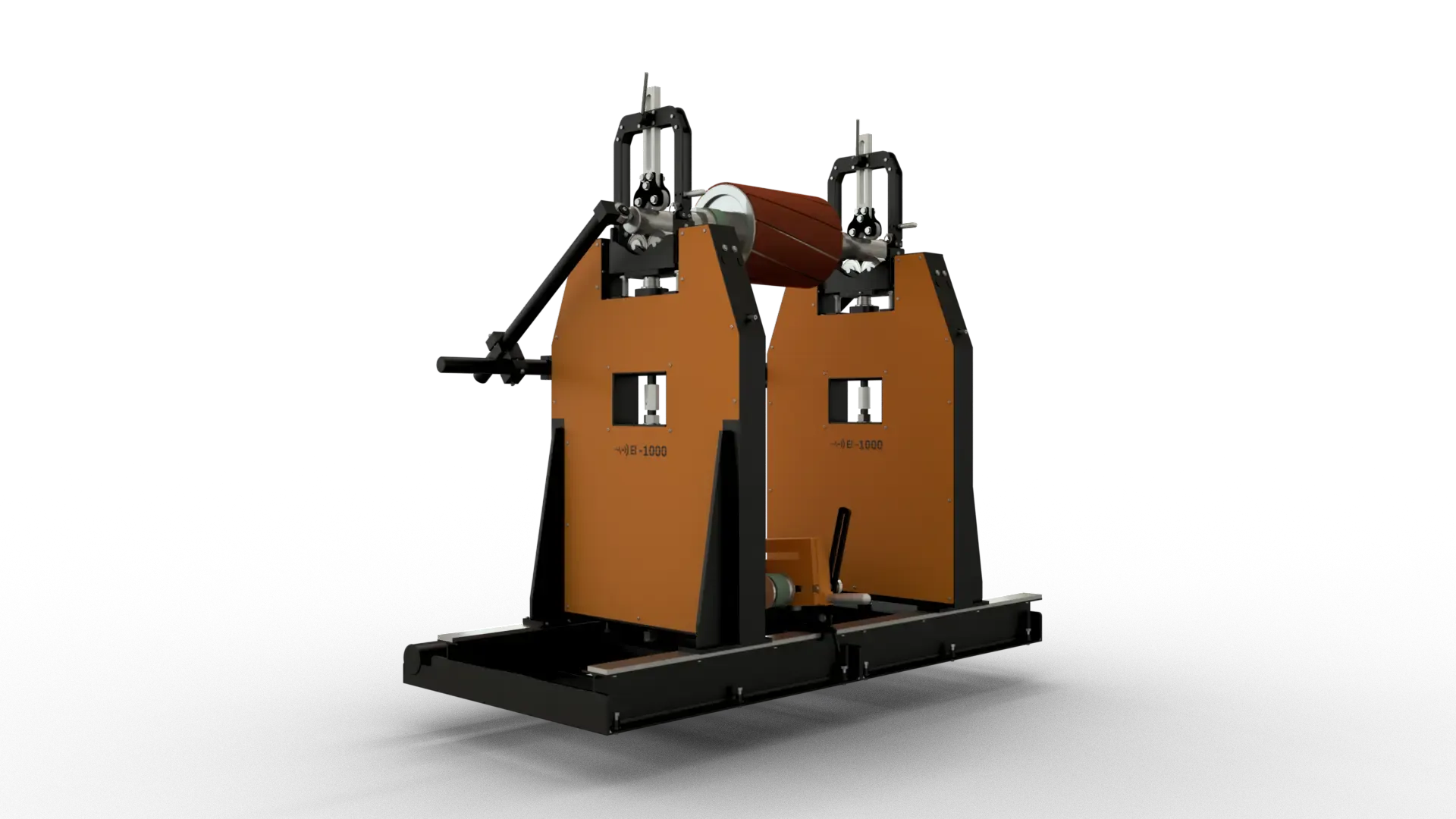
From 50 grams to 50 tonnes, on a level floor. 100 tonnes on request.
The EI-30 balances turbocharger wheels from 50 grams at up to 15,000 RPM. The EI-150 to EI-6000 cover the workshop, from 5 kilograms to 6 tonnes, with a residual unbalance of 0.2 g·mm/kg. The EI-10T, EI-25T and EI-50T take rotors up to 50 tonnes as standard models, with 1 g·mm/kg, and we build to 100 tonnes on request. None of them needs a concrete foundation, and none of them needs its suspension recalibrated when the rotor changes: the sensors are what you calibrate, as on any analyzer.
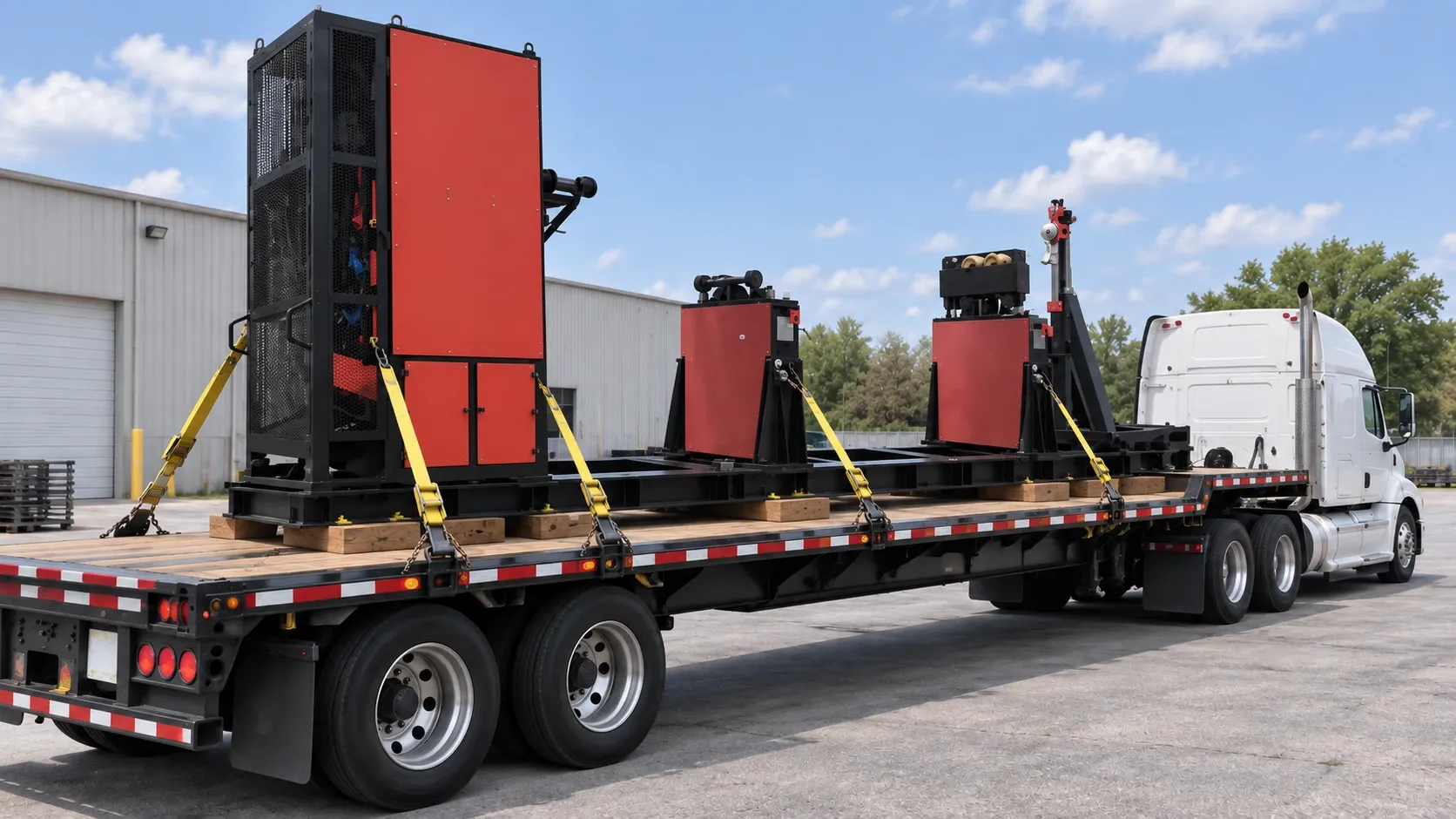
The machine goes to the rotor
Picture an 800-kilogram balancing machine and a 20-tonne rotor. Shipping the rotor to a workshop means a crane, a low-loader and a week without the machine it came from. Shipping the balancer means a small truck. Because the machine needs no foundation, you unload it, level it, connect it and mount the rotor where it will be reinstalled.
And when even that is too much, the electronics go alone: the interface and the sensors balance the rotor in its own bearings, and the same software analyses the vibration if the problem turns out to be something else.
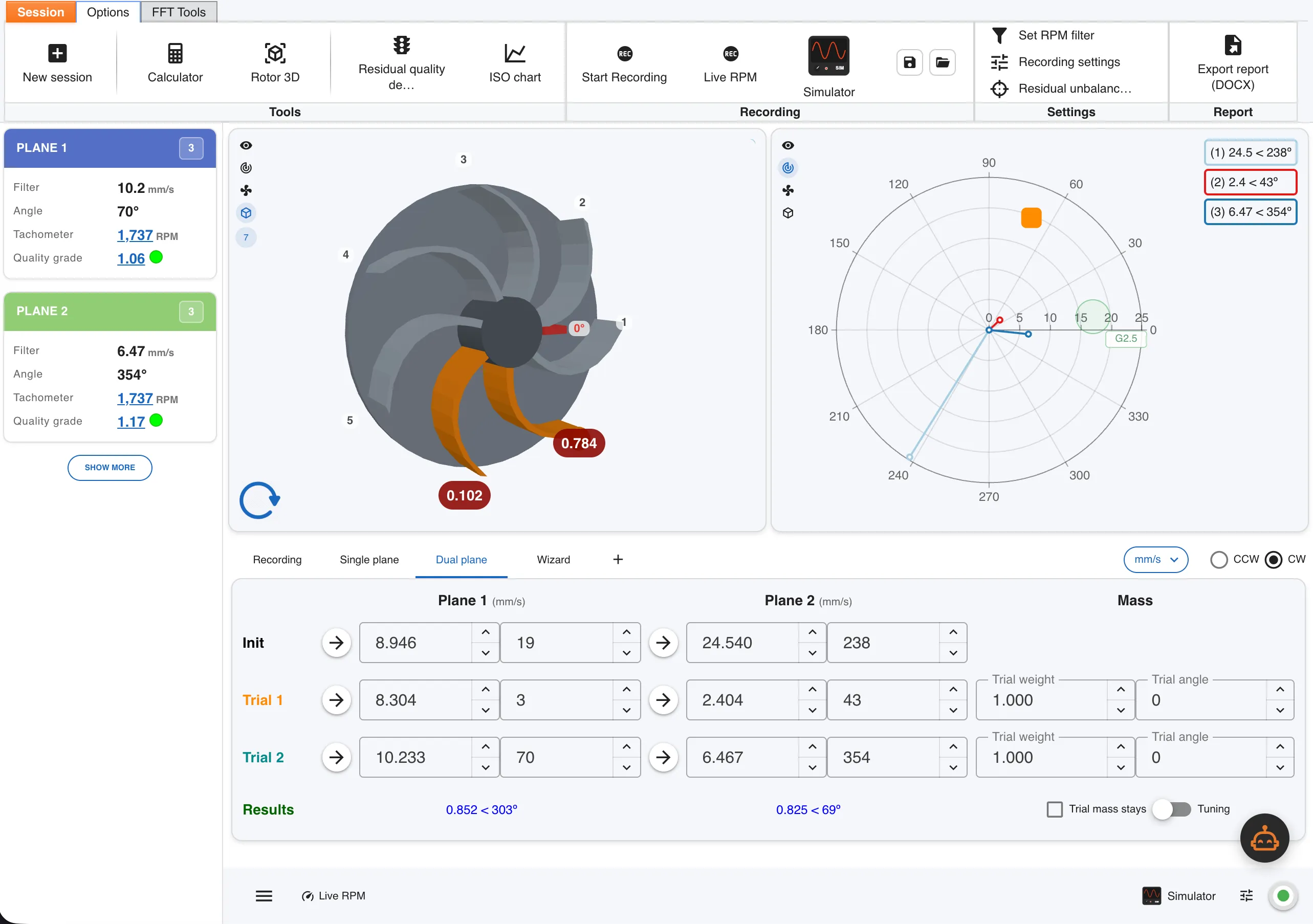
The software sets the target before the first run
Specification 8 is a list of functions. Digivibe MX® has them all: one, two and three planes, the calculator, the four-run method, stored coefficients and the editable ISO 21940 report with the initial and final state. The Balancing Wizard is what removes the trial-weight run: from the rotor’s geometry it derives the mass, the quality grade and the influence coefficients, so the measuring run is the only run before the correction. And it adds the part that saves the most time: Erby builds the rotor from a photo. One reference dimension, and the assistant fills in the wizard for you. You review, and you decide.
Where it is not the right fit
Three cases, stated plainly:
- If the rotor is a wheel. Car and truck wheels are balanced on a wheel balancer with a rim adaptor, to a tolerance and at a price an industrial machine is not built for. That is a different purchase.
- If you need a fully automated station. A line where the rotor is loaded, measured and corrected by the machine itself, with drilling or milling built into the cycle, is a dedicated production balancer, and we do not build those. For series production where a person mounts the rotor, a soft-bearing machine with the rotor type stored is a one-run job, and the EI Series does that every day.
- If the rotor cannot come out. Then you do not need a machine, you need a field balancing kit: an analyzer, a sensor and a tachometer. Ours is the same Digivibe MX® that runs the machines, so if you later buy the machine, you already own the electronics.
FAQs about choosing the best balancing machine
What is the best balancing machine?
The one sized to your rotors from the lightest to the heaviest, that reaches the ISO 21940 grade they require with margin, and that does not tie you to a foundation, a calibration routine or one place of work. Judge any candidate, ours included, on the same ten specifications: minimum and maximum rotor mass, rotor geometry, drive type, speed range, residual unbalance at your rotor mass, suspension and calibration, foundation, software, whether the electronics can leave the bed, and the five-year cost. For a workshop that sees a different rotor every day, a soft-bearing machine covers the widest range with the best sensitivity and can travel to the rotor. That is how the EI Series is built. We make it, so weigh that when you read our answer.
What is the difference between a balancing machine and field balancing?
A balancing machine spins the rotor on its own supports; field balancing spins it in its own bearings. On the machine the rotor has been removed, the supports have a known response and the measurement is clean, so the machine can reach a fine residual and certify it against a standard. In the field the rotor stays installed and runs at operating speed, which saves the removal but limits the result to what the rotor’s own structure allows: a resonant foundation or a loose bearing will not balance out no matter how much weight you add. Most workshops end up with both, and with our equipment the same electronics do both jobs.
When does a hard-bearing machine make more sense than a soft-bearing one?
When you need a correct reading on the very first run of a rotor you have never seen, and the rotor is heavy enough for a rigid support to feel it. A hard-bearing machine is calibrated once at the factory and reads force, so a new rotor type needs neither a wizard estimate nor a trial-weight run. A soft-bearing machine gets its influence coefficients from the rotor wizard, with no trial weight at all, or from one trial run whose coefficients are then stored and reused on the same or a similar rotor, so on cycle time the two are even in series production. What the soft-bearing machine gives you in exchange is sensitivity on light rotors and independence from the floor, which is what lets it leave the workshop. Choose by your lightest rotor and by whether the machine ever has to travel, not by which one is “better”.
How do I size a balancing machine to my rotors?
List your rotors by mass and buy for both ends. The maximum decides the bed and the supports; the minimum decides whether the machine can feel the rotor at all, and it is the number brochures leave out. Then check geometry: diameter over the bed, length between supports, bearing span within the support travel, journal diameters within the rollers. If the spread from your lightest to your heaviest rotor is too wide for one design, two machines will serve you better than one that cannot detect the small ones.
What residual unbalance should a balancing machine achieve?
Less than the permissible residual for your rotor’s ISO 21940-11 grade, with margin, measured at your rotor mass. The standard gives each rotor type a grade, from G 0.4 to G 40, and the grade plus the operating speed gives the permissible residual in g·mm per kilogram of rotor. A machine that reaches 0.2 g·mm/kg covers the grades a service workshop meets; heavy machines typically reach 1 g·mm/kg, which is enough for the large, slower rotors they take. Ask for the figure at the mass of your rotors, not at the rotor that flatters the machine.
What drive type do I need: belt or end drive?
Belt for most rotors, turbochargers included; end drive for rotors with no free belt surface. A belt around a plain section of the shaft is the fastest setup and needs no coupling. A keyed shaft end, or a rotor with no room for a belt, is driven from the end through a universal joint. Turbocharger cartridges are driven by a belt resting on the shaft, on floating supports: a well-proven arrangement, precise down to 50 grams, that does not need to reach the operating speed because the quality grade is adjusted for the operating speed and the balancing speed. Ask how the machine handles the rotor in your workshop that has nowhere for a belt, and what the fixture for it costs.
Does a balancing machine have to run the rotor at operating speed?
No. It has to run above the resonance of its own suspension and below anything that endangers the rotor. Unbalance is a mass, and a mass does not change with speed; only the force it produces does. The measurement is stable once the machine is above its suspension resonance, which on a soft-bearing machine can be a small fraction of the rotor’s running speed, and the software calculates the quality grade for the full operating speed regardless.
Is a balancing machine the same as a wheel balancer?
No. A wheel balancer is a machine for car and truck wheels: a spindle, a rim adaptor and a tolerance suited to a tyre. An industrial balancing machine takes rotors on their own journals or on an arbor, from a turbocharger wheel to a 50-tonne generator rotor, and certifies them against ISO 21940. They share a word and nothing else. If you searched for “best balancing machine” looking for a tyre shop machine, this guide is not the one you need.
Can I build my own balancing machine?
Yes, if you buy the two parts that need a manufacturer and make the rest. The soft-bearing suspensions and the measuring system are what give the machine its precision; the bed is steel, and any workshop that can weld a frame can build it from drawings. That is what our SBS suspensions are for: you get the suspensions, the electronics and the drawings, and you skip the ocean freight on several tonnes of steel and adapt the length and height to your own rotors.
What does a balancing machine cost over five years?
The invoice plus five items that rarely appear on it. Fixtures for your awkward rotors; civil works, if the machine needs a foundation; shipping and installation, because these machines are heavy and usually cross an ocean; spares, with their lead time; and licences or updates, if the vendor charges annually for the software. Ask for all of them in writing before you compare two quotations. A machine that needs no foundation and whose software carries no annual fee can be the cheaper one by year two even if it is not the cheaper invoice.
Further reading